The plan was that I would go on holiday to Northumberland and take some lovely pictures of the fells and the hardy Hexham Black Face sheep that are kept in the area. Well a bad back starting day two of the holiday meant that I spent most of the time laying on a sofa, literally my bed of pain.
HBF sheep live out on the fell all year round they lamb outside needing very little help. Extra food is only given in the worst of weathers. The fleece of these tough little animals is very course, straight locks that the rain slides off, dense and hairy for warmth.
You might think that the hand spiner would have little use for this kind of fleece but it was an interesting exersise spinning it. I found it very easy to spin an even yarn. Making it a good fleece for a beginer to start with. As long as you don't want to wear the result and have another use like rug or bag making in mind your item should be very tough and last a long time. The sheding of the hairy bits will be a problem if you are not careful when sorting the fleece at the start. Leave out the worst of the gard hair.
Sorry no photos I'll try again next time.
Wednesday, 14 September 2011


Wednesday, 3 August 2011
Jacob Fleece
 I have just taken on a commission and I don't usually do that. In the past I have found myself spending a lot of time working on a project that I do not like which may or may not be going well. There is usually a dead line, and that does not suit me either as my work has to fit in with the rest of my life and I can't always spend my time as I would like. Luckily the client has always liked the finished article.
 This time is a bit different as the client has supplied the wool from her own sheep, a flock of Jacobs in our village. I helped on shearing day and know the sheep personally. I love that. The wool is lovely to work with and I have made a similar jumper before so I know that I will enjoy doing it.
 Jacobs are a medium size sheep, brown and white with two or sometimes four horns. Easy to look after and very friendly. Two colours in the fleece make for supper patterns in the finished yarn.
Sunday, 17 July 2011
Cilpping a Rabbit
 I only have two Angora rabbits at the moment a white one, Daisy, and a light grey one called Conner. It was Daisy's turn to be clipped this week. She is very good when I do this as she is used to it and I have become quite quick. It usually takes me about 20 to 30 minutes. Some commercial producers are much faster that this, but I like to take time to be careful not to catch the rabbit with the scissors. That is very easy thing to do as they have such loose skin. Most rabbits need clipping every 10 to 12 weeks, if you leave it any longer they become matted which is bad for the rabbit and makes it much more difficult to clip them. That makes the job take longer and upsets the rabbit which makes it struggle and more difficult to clip. A vicious circle.
Angora is a lovely fibre to spin, there is nothing softer. But it is not easy to do well and needs some practice. Some people are allergic to Angora so check before you try to spin any.

Thursday, 16 June 2011
Fleeces and Demos.
This has been a week of collecting fleeces and doing demos at a farm open day. Both things over lapped a bit.
I often get calls from various by contacts when they have fleece to sell. This year it started early because it was so warm farmers sheered early. Some of the fleeces are not such good quality because of this, a bit shorter mostly. Which can make them more difficult to spin. So far I have picked up Ryeland, Black ,Welsh Mountain, Shetland and a few unidentified bags of white fleece. That can some times be a problem when deciding what to do with them but they look fairly good quality and they should dye well so I am pleased. That won't be the end I'm sure. I can't open my shed door with out all these bin bags of dirty fleece falling out. There is lots of washing to do this summer.
The farm open day was a bit disappointing as so few people turned up. It is such a lot of work to stage these events and I feel very sorry for the organisers when they don't go so well. I don't mean it was a total falier, the people who did come had a great time especially the children. My friends and I had a lovely day spinning. We did not sell any thing, but neither did any of the other stalls, well not much any way. I did buy some fancy dog biscuits for my lurcher Mia. She liked them which was just as well as they were expensive for dog food. The over lap came when I was given two bags of BWM fleece buy the farmer which was very nice of him but as I have so much already I gave it to my fellow spinners. It is sad to think it is not worth him trying to sell it, the wool board is not interested in coloured fleece.
We were opposite a stall advertising Medical Assistance Dogs. So interesting they way they can sniff out different things from fluid samples, cancer cells, diabetes, lots of different illnesses that can be hard to detect in a lab. They only work in laboratory's not on people, although I think I would prefer a dog to some people I have met in hospitals. A worthy charity to support if you are looking for one.
I often get calls from various by contacts when they have fleece to sell. This year it started early because it was so warm farmers sheered early. Some of the fleeces are not such good quality because of this, a bit shorter mostly. Which can make them more difficult to spin. So far I have picked up Ryeland, Black ,Welsh Mountain, Shetland and a few unidentified bags of white fleece. That can some times be a problem when deciding what to do with them but they look fairly good quality and they should dye well so I am pleased. That won't be the end I'm sure. I can't open my shed door with out all these bin bags of dirty fleece falling out. There is lots of washing to do this summer.
The farm open day was a bit disappointing as so few people turned up. It is such a lot of work to stage these events and I feel very sorry for the organisers when they don't go so well. I don't mean it was a total falier, the people who did come had a great time especially the children. My friends and I had a lovely day spinning. We did not sell any thing, but neither did any of the other stalls, well not much any way. I did buy some fancy dog biscuits for my lurcher Mia. She liked them which was just as well as they were expensive for dog food. The over lap came when I was given two bags of BWM fleece buy the farmer which was very nice of him but as I have so much already I gave it to my fellow spinners. It is sad to think it is not worth him trying to sell it, the wool board is not interested in coloured fleece.
We were opposite a stall advertising Medical Assistance Dogs. So interesting they way they can sniff out different things from fluid samples, cancer cells, diabetes, lots of different illnesses that can be hard to detect in a lab. They only work in laboratory's not on people, although I think I would prefer a dog to some people I have met in hospitals. A worthy charity to support if you are looking for one.
Sunday, 15 May 2011
Mordanting
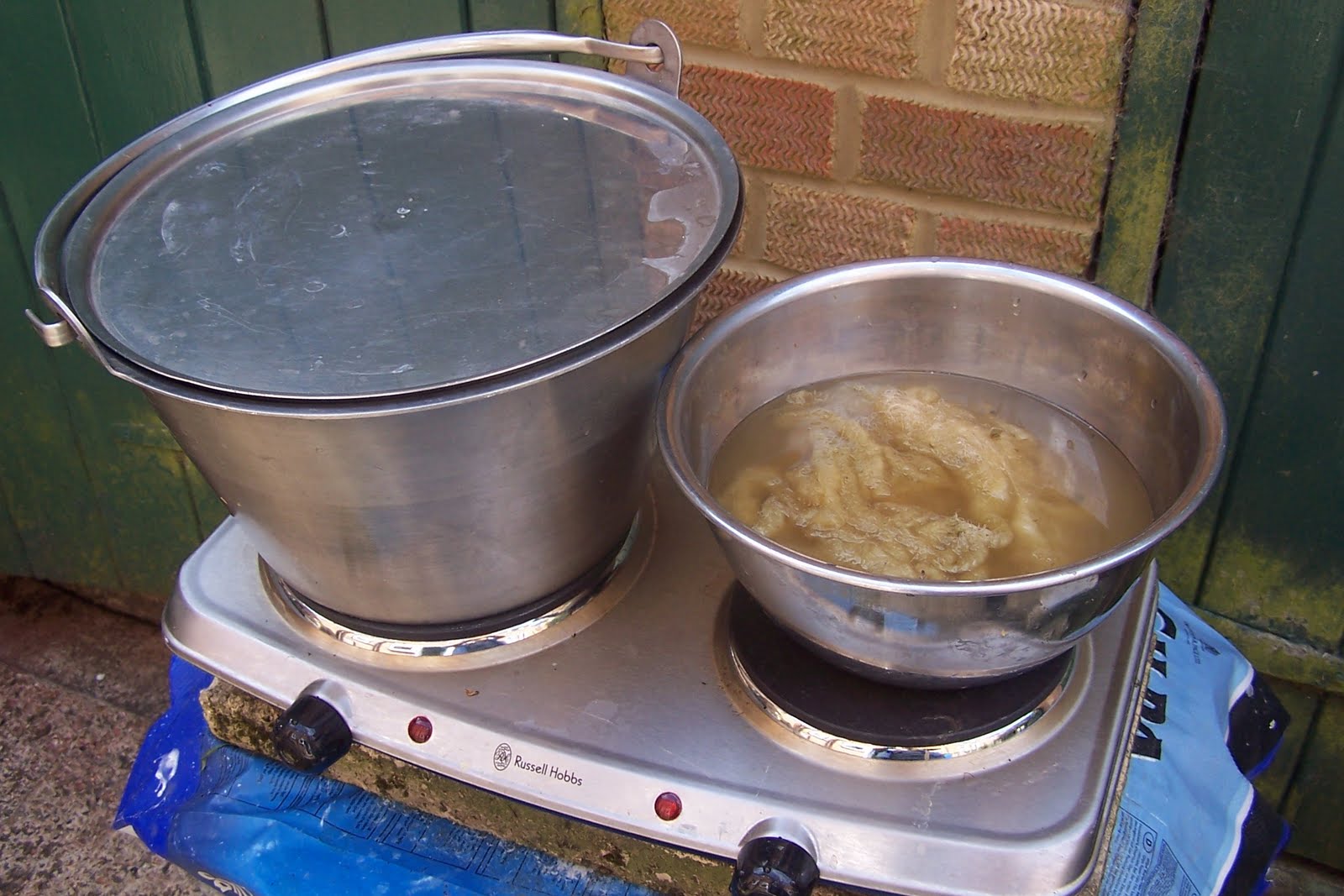 When I talk about natural dyeing most people ask if the colours are light fast and washable. The answer is yes if you use the right methods of dyeing and mordants. Mordants are the chemical fixers used to fix the dye to the fibre. Years ago I used to use Tin, Copper, Chrome and Iron until I realised how poisonous they are. Now days I use Alum, natural and harmless. This can restrict the colours that you get so I started making safe alternatives.
 Soak copper piping in a solution of half vinegar and water for about three weeks until it turns blue. This is a good mordant and you just need to top up the solution as you use it until it no longer turns blue then change the piping.
Treat rusty iron nails in the same way. Be careful as this can be a bit hard on the wool and make it brittle. Best used as a modifier.
 Rhubarb leaves simmered for one hour then strained make a mordant and a yellow dye in there are own right. The root of the plant can be used in the same way. This is no hardship, I love Rhubarb.
Modifiers are used at the end of the dyeing process to alter the colours by making the solution either acid or alkaline. Citric Acid, Vinegar for acidic solutions and Washing Soda for alkaline are just a few that are available. It is best to use these sparingly as they can damage the fibre, but you don't need much to change the shades in the dye bath.
I like to mordant a lot of wool ready to dye at this time of the year because dye plants are coming thick and fast form now on and time is short. It is a way to make sure I am ready to use the ones I want before they disappear for another year. There are always some I miss, there are just not enough hours in the day to do all I want to do.
Saturday, 30 April 2011
Fleece Washing.
Fleece washing is not the most exciting job to do, but it has to be done, and I will have to be doing a lot of it over the next few weeks. It is a dirty sometimes smelly job. I like the smell, if this makes me a bit weired whats new. I like the smell of sheep. It uses a lot of hot water and elbow grease but a good job done now can save you a lot of work later. And effect the end result of your spinning.
When you collect as many fleeces as I do it is not unusual to find that you have some unwashed fleeces from last year. This is what happened to me so I have started on last years first, before the new fleeces start coming in. Many people ask me where my fleeces come from. All I can say is that over the years I have become known as some one who will buy a good fleece. It is all word of mouth mainly through the Bucks Guild of WS&D's. It pays to spend time developing contacts. I was contacted out of the blue buy the person who sold me my horse 12 years ago. She has 25 Black Welsh Mountain sheep and wants to know if I want any fleeces. Sometimes contacts go back a long way.
When I wash a fleece I divide it up into 3 or 4 lots depending on the size. This is to make it manageable. If there is a lot of variation in the fleece you can put different quality of wool in each lot.
The next stage is to soak the wool in tap hot water and washing up liquid , not to much or it will be difficult to rinse out. But you need enough to get the grease out. This will vary from fleece to fleece. If the wool is very dirty after an hours soak I change the water add more washing up liquid and soak for 24 hours. Don't be tempted to agitate the wool or you will felt it.
The next stage is rinsing. I use cold water and I am lucky enough to have an old stand alone spin dryer which does not felt the wool and makes rinsing easier if you spin between each rinse. The fleece is then spread out on my chicken shed to dry. You can use onion bags or anything you have to hang it on a washing line, or any method that is easy for you. Not a tumble dryer or artificial heat. This will felt and shrink the wool.Don't risk your washing machine or you will really be in trouble and wreck it.
I do not worry if all the dirt is not washed out. Any dirt that won't come out with carding or spinning is discarded with the fleece. I always wash the skeins I spin to set the twist so no dirt should survive all that.
When you collect as many fleeces as I do it is not unusual to find that you have some unwashed fleeces from last year. This is what happened to me so I have started on last years first, before the new fleeces start coming in. Many people ask me where my fleeces come from. All I can say is that over the years I have become known as some one who will buy a good fleece. It is all word of mouth mainly through the Bucks Guild of WS&D's. It pays to spend time developing contacts. I was contacted out of the blue buy the person who sold me my horse 12 years ago. She has 25 Black Welsh Mountain sheep and wants to know if I want any fleeces. Sometimes contacts go back a long way.
When I wash a fleece I divide it up into 3 or 4 lots depending on the size. This is to make it manageable. If there is a lot of variation in the fleece you can put different quality of wool in each lot.
The next stage is to soak the wool in tap hot water and washing up liquid , not to much or it will be difficult to rinse out. But you need enough to get the grease out. This will vary from fleece to fleece. If the wool is very dirty after an hours soak I change the water add more washing up liquid and soak for 24 hours. Don't be tempted to agitate the wool or you will felt it.
The next stage is rinsing. I use cold water and I am lucky enough to have an old stand alone spin dryer which does not felt the wool and makes rinsing easier if you spin between each rinse. The fleece is then spread out on my chicken shed to dry. You can use onion bags or anything you have to hang it on a washing line, or any method that is easy for you. Not a tumble dryer or artificial heat. This will felt and shrink the wool.Don't risk your washing machine or you will really be in trouble and wreck it.
I do not worry if all the dirt is not washed out. Any dirt that won't come out with carding or spinning is discarded with the fleece. I always wash the skeins I spin to set the twist so no dirt should survive all that.
Tuesday, 19 April 2011
The unplaned project.
I have had the most horrible cold and have not felt like doing much of anything for nearly a week. This has  given me some time to think about how I am going to finish the pinafore top I wrote about last time. I do have enough of the recycled mohair and Shetland mix to finish the bands and straps, it's the triangle panels of the skirt that are the problem.
 given me some time to think about how I am going to finish the pinafore top I wrote about last time. I do have enough of the recycled mohair and Shetland mix to finish the bands and straps, it's the triangle panels of the skirt that are the problem.
 At first I was using a madder dyed pink fleece, (Oxford Down) hand carded and spun with some space dyed pink, red silk. I rolled the silk into the rolag before spinning and was very pleased with the results. Then as I ran out of fleece I had to think again. Fortunately there was some similar coloured fleece in my stash but the method of spinning did not suit it so well. It was not labeled so I dont' know what it is. There's a lesson to remember LABEL EVERY THING. It's not hard and can save you a lot of trouble.
 This fleece worked better if I spun it straight no carding. Then I spun a single of silk and plied them together. The colours link these two different yarns enough for me to work them into the pattern of the piece. At least I hope they will. Watch this space for the finished article and judge for yourself.
Subscribe to:
Posts (Atom)